What Is Oxidative Stress and Why It Matters
What Is Oxidative Stress and Why It Matters
There is a moment that many people know but rarely talk about.
You're sitting in the middle of an ordinary day. Nothing dramatic has happened. No crisis. No reason to feel the way you do.
And yet something feels heavier than it should.
Maybe it's the way your body moves through the afternoon. A little slower. A little less clear. Like you're operating just slightly below the version of yourself you know is in there.
You brush it off. Because everything on the outside looks fine.
But that feeling keeps showing up. Quietly. Consistently. In the background of an otherwise normal life.
That's usually where the real conversation begins.
Not in a doctor's office. Not after a diagnosis. But in those small, honest moments when the body is trying to tell you something that a standard checklist was never designed to catch.
What is oxidative stress? It might just be the answer to a question you didn't know you were asking.
Most people don't realize that feeling often starts at the cellular level, long before it shows up anywhere else.
What Is Oxidative Stress and Why Does It Matter?
Most people have heard the term. Few people know what it actually means.
What is oxidative stress? It's not a diagnosis. It's not a deficiency you can test for on a standard blood panel. It's a process, a slow, cumulative kind of internal pressure that builds at the cellular level.
Understanding it doesn't just answer a science question. It changes the way you see your health entirely.
What this really means:
Oxidative stress is not a disease. It's a biological condition.
It builds gradually, often without obvious symptoms in the early stages.
It is caused by an imbalance between free radicals and the body's ability to neutralize them.
The body has natural, built-in systems designed to manage this balance.
When those systems become overwhelmed, the body starts to feel the effects.
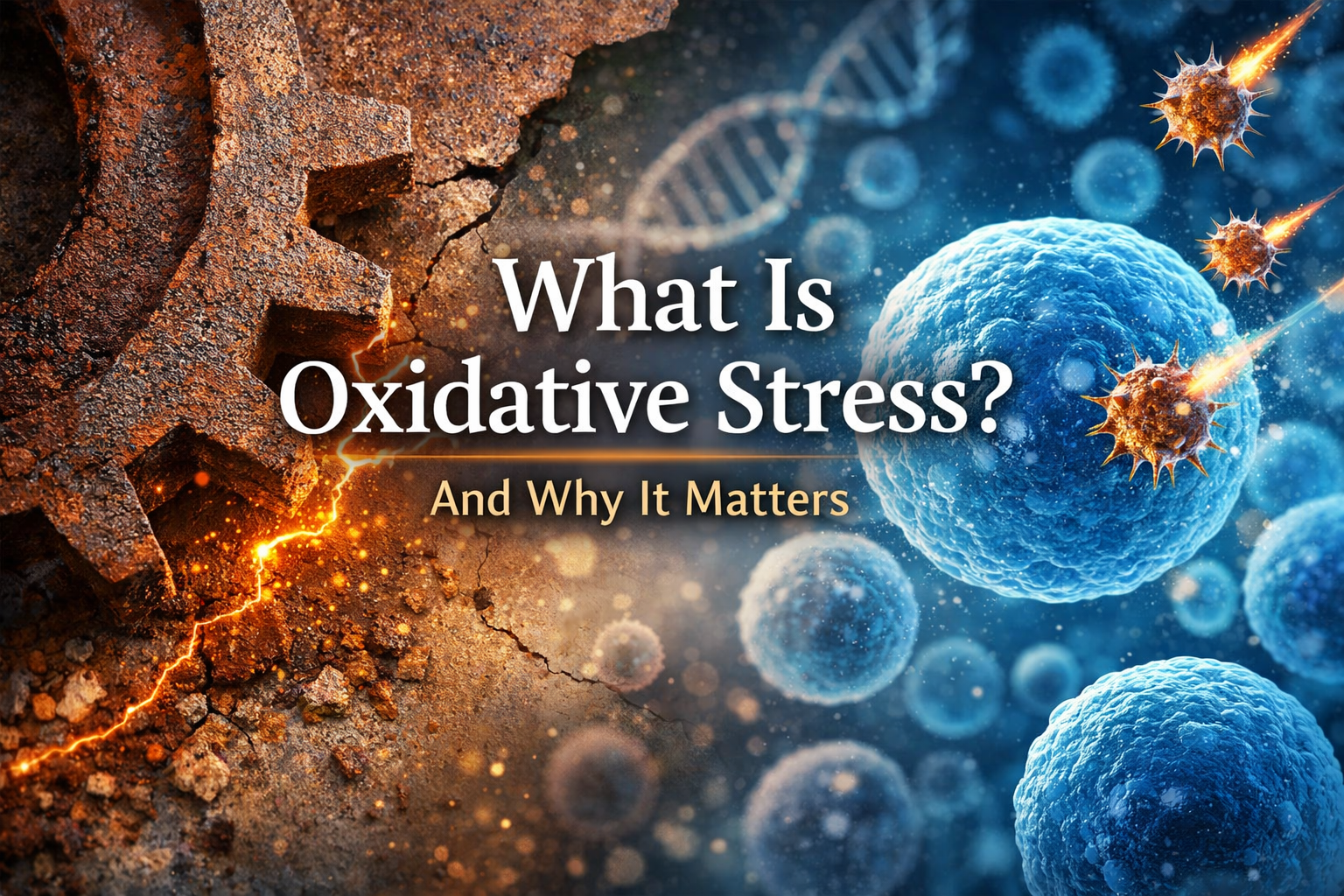
Think of It Like Rust
The simplest way to understand what oxidative stress is is through a familiar image.
Think about what happens to metal when it's left exposed to oxygen and moisture over time. It doesn't collapse overnight. It slowly corrodes. The surface changes. The structure weakens. Eventually, it stops functioning the way it was designed to.
That's rust. And within the body, oxidative stress works similarly.
Every day, your body is exposed to substances that generate free radicals. These are unstable molecules that, in excess, begin to damage cells, proteins, and DNA. This isn't dramatic or sudden. It's gradual. And that's precisely what makes it so easy to overlook.
The sources are everywhere in modern life:
Environmental toxins: air quality, household chemicals, everyday exposures
Emotional stress: chronic worry, pressure, and unresolved tension
Processed foods: particularly those high in refined sugars and industrial oils
Poor sleep: the body does the majority of its cellular repair overnight
None of these things causes immediate harm on its own. However, over time, the accumulation of oxidative pressure begins to affect how the body functions at its most foundational level.
If you've ever wondered why you can do everything "right" and still not feel your best, this is often part of the answer.
→ For a deeper look at how to support the body in managing this, see How to Reduce Oxidative Stress.
The Body Was Built for This, But It Needs to Be Activated
Here's something that often gets missed in the conversation around oxidative stress.
The body is not passive. It was never designed to simply absorb damage without a response. Inside every cell, there are sophisticated repair systems built specifically to neutralize free radicals, reduce internal damage, and restore balance.
One of the most important of these is called the NRF2 pathway. This is the part most people never hear about.
In simple terms, NRF2 is like a master switch inside the cell. When it's activated, it signals the body to produce its own antioxidant enzymes. These are compounds the body produces in a coordinated way that's difficult to replicate externally. They work intelligently and in sync with each other.
Think of it like an internal repair crew. The crew exists. The tools are there. The question is whether the crew is being called into action or whether years of accumulated stress have quieted the signal.
This is where the concept of activation becomes important. Not adding more from the outside in. But supporting what the body already has the capacity to do.
→ Learn more about what activation really means here: What Activation Really Means.
Why This Gets Missed
Most standard health appointments are not designed to catch this.
A normal blood panel assesses markers such as cholesterol, blood sugar, and organ function. These are important. But they don't measure the level of oxidative burden your cells are carrying. They don't assess how well your internal repair systems are functioning. They don't tell you whether your body is managing its daily load or quietly accumulating damage over time.
As a result, when someone comes in feeling tired, foggy, or just off, and every number looks fine, they're often sent home without answers.
Fine and functioning well are not the same thing.
This is the root-cause gap. Most approaches focus on managing symptoms after they appear. Very few focus on the cellular environment that allowed those symptoms to develop in the first place.
Research published in Oxidative Medicine and Cellular Longevity (Pizzino et al., 2017) highlights how chronic oxidative stress is connected to a wide range of conditions, and how addressing it at the cellular level rather than treating symptoms downstream represents a meaningful shift in how we approach long-term health.
What It Can Look Like
Oxidative stress doesn't usually announce itself clearly. In many cases, it shows up in quieter, more frustrating ways.
You might notice:
Energy that doesn't restore with rest: sleeping enough but still waking tired
Mental fog or slow processing: thoughts that feel harder to access than they used to
Skin that's slower to recover: dullness, slower healing, a loss of that natural glow
A general sense of imbalance: not sick, but not quite right either
These are signals. Not diagnoses. The body communicates that something in its internal environment needs attention.
The difference between addressing those signals at a symptomatic level versus a cellular level is significant.
→ For more on how this connects to brain function: Brain Health Begins in the Cell
Simple Ways to Support Your Body
You don't need a complicated protocol to start moving in the right direction. A few foundational shifts can make a real difference in how much oxidative pressure your body is carrying.
Prioritize consistent sleep: This is when most cellular repair occurs.
Reduce processed food intake where you can: even small changes reduce the oxidative load.
Manage chronic stress: Emotional stress is one of the most underestimated contributors.
Focus on supporting the body, not overwhelming it: more is not always the answer
These aren't quick fixes. They're the kind of steady, foundational choices that give the body a better environment in which to work.
A Different Way of Looking at It
What if the focus shifted?
Instead of constantly searching for the next thing to add, the next supplement, the next protocol, the next fix, what if the question became: Is my body actually able to do what it was designed to do?
That's the shift that cellular activation is built around. Not replacing the body's systems. Not overriding them. Supporting them. Giving them the conditions they need to function the way they were designed to.
This is inside-out health. And for many people, understanding what oxidative stress is is the first step toward a framework that finally makes things click.
If you've never looked at your health from this angle before, it might be worth understanding what's happening beneath the surface before the body starts asking louder.
What This Is Not
Because clarity matters here.
This is not a quick fix. Understanding oxidative stress and supporting the body's response to it are foundational shifts, not overnight transformations.
This is not about adding more supplements to your routine. In fact, the approach is almost the opposite. It's about working with what the body already has rather than trying to replace it.
This is not a replacement for your doctor or your current care team. It's a complementary layer of awareness, one that asks a different set of questions.
The people who resonate with this tend to be the ones who've already tried many things and are starting to ask whether there's a more fundamental piece they've been missing.
→ This same inside-out approach applies to cardiovascular health too: Heart Health from the Inside Out.
Frequently Asked Questions
What is oxidative stress in simple terms? Oxidative stress is an imbalance inside the body between free radicals, unstable molecules that can damage cells, and the antioxidant defenses the body uses to neutralize them. When free radicals accumulate faster than the body can manage, cellular damage builds over time. It's often described as internal wear and tear at the cellular level.
What causes oxidative stress in the body? Common contributors include environmental toxins, chronic emotional stress, a diet high in processed foods, lack of quality sleep, and excessive physical strain. These factors increase the production of free radicals while often depleting the body's natural ability to keep them in check.
What are common signs of oxidative stress? There is no single definitive symptom, which is part of what makes it easy to miss. Common signs include persistent fatigue that doesn't resolve with rest, mental fog, slow physical recovery, skin changes, and a general sense that the body isn't functioning at its best, even when standard health markers appear normal.
Can the body reduce oxidative stress on its own? Yes. The body has sophisticated built-in antioxidant systems, including pathways like NRF2, that are designed to neutralize free radicals and support cellular repair. The challenge is that modern lifestyle factors can overwhelm or suppress these systems over time. Supporting the body's ability to activate these pathways is a meaningful part of addressing the root of oxidative stress.
Is oxidative stress the same as inflammation? They are closely related but not the same thing. Oxidative stress often contributes to inflammation. Chronic free radical damage can trigger inflammatory responses in the body. Many researchers view them as part of the same underlying cycle, which is why addressing oxidative stress at the cellular level can have a broader effect on overall body function.
The Bottom Line
Most people are managing their health from the outside in.
They're adding things, adjusting things, chasing symptoms. And still wondering why they don't feel the way they should.
Understanding what oxidative stress is is not about having another thing to worry about. It's about having a clearer picture of what might actually be going on, and why inside-out health is a fundamentally different conversation.
It's not about doing more. It's about understanding what your body needs to function again.
If you're curious to see what this could look like for you, I'm always happy to have a conversation.
Book a free Activation Call at moniquemannen.com/contact
This blog is for educational purposes only and is not intended to diagnose, treat, cure, or prevent any disease. Always consult your healthcare provider. Individual results may vary.
Remember to Do Things That Make You Smile. Health is wealth!