Why Am I Still Tired Even When I Sleep Enough
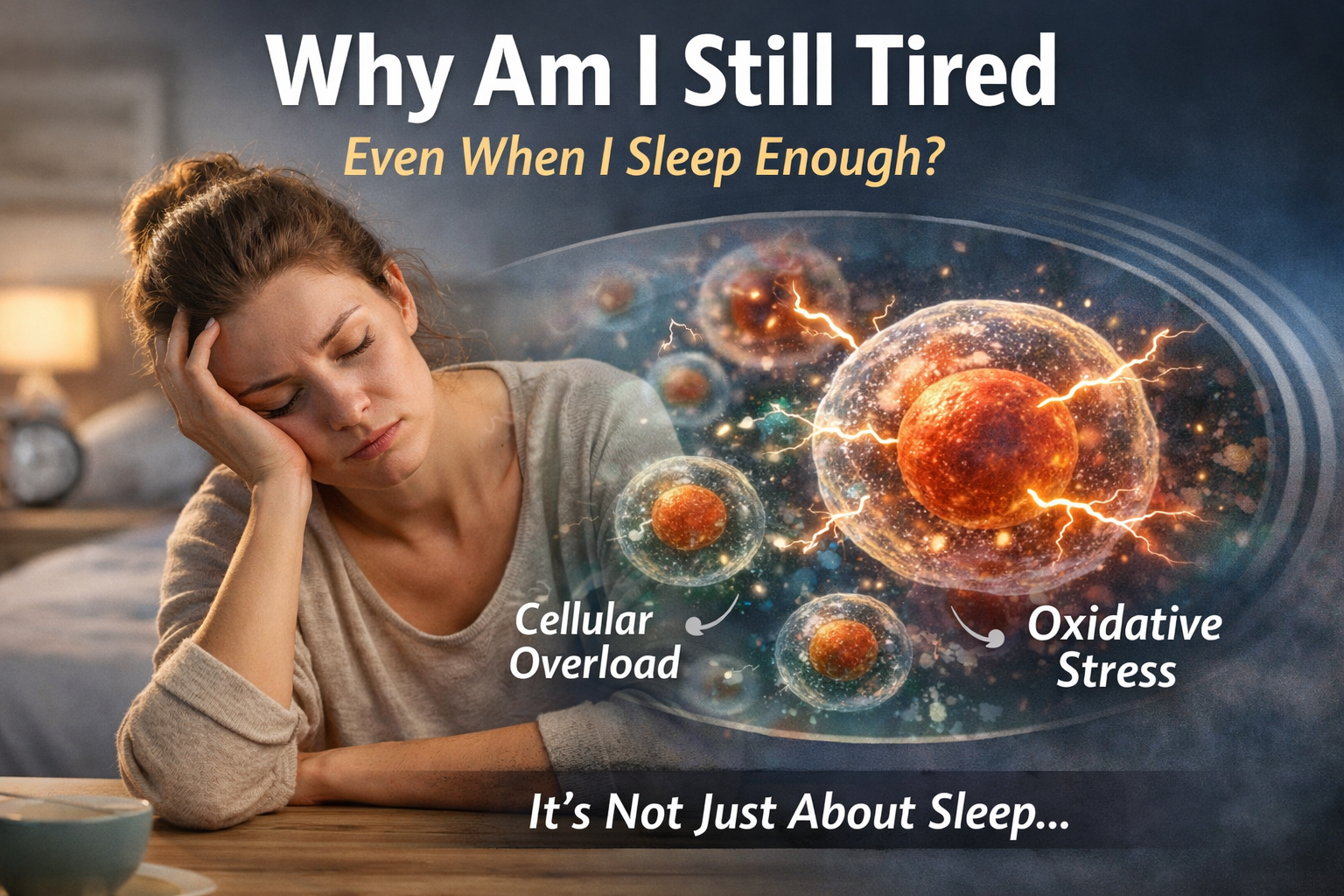
She went to bed early.
She woke up, made her smoothie, took her supplements, and went for a walk.
She was doing everything she'd been told to do.
And by 2 pm… she was exhausted again.
Not the kind of tired that a nap fixes. The kind that sits behind your eyes. The kind that makes you feel a little disconnected from yourself, like you're going through the motions but not quite in your body.
If that sounds familiar, this is for you.
When You're Doing Everything Right and Still Don't Feel Right
This is one of the most common things I hear.
"I'm not doing anything wrong. Why do I still feel this way?"
And too often, the response from the outside world is: "You're getting older. This is normal. Everything looks fine."
But here's the thing. Feeling chronically off is not a normal baseline. It's information.
The question is whether we're asking the right questions to understand it.
Why Am I Still Tired Even When I Sleep Enough? The Missing Piece
Here's a perspective shift that might change how you look at this.
For many people, the issue isn't a lack of effort. It isn't even a lack of nutrients, sleep, or healthy habits.
It may be that the body is overwhelmed at a level most people never look at: the cellular level.
Most people never think to look here, because no one ever told them to.
Your cells are working constantly. Every second of every day, they're protecting, repairing, and rebalancing your system. That's not poetic language. That's literally what's happening beneath the surface.
But over time, with the accumulation of daily stress, environmental exposure, processed inputs, and the general load of modern life, those cellular systems can get overloaded.
And when they do, the body starts sending signals.
This doesn't mean every case of fatigue is due to this, but it's a layer many people are never shown. And for those who've tried everything on the surface without lasting results, it's often the most important place to look.
What this can look like:
Low energy that doesn't resolve with rest
Brain fog or that "can't quite think straight" feeling
Skin changes or dullness
Hormonal shifts
Feeling emotionally flat or disconnected
Waking up unrefreshed even after a full night of sleep
None of these is dramatic. None of them will necessarily show up on a standard panel.
But they're real. And they matter.
The Real Reason Rest Isn't Fixing It
Think of it this way.
Imagine a filter in your home that's been running for years without being cleaned. You keep pouring clean water through it, good intentions, good inputs, but the filter itself is clogged.
The water still comes through. But it's not as clean as it could be.
That's a little like what happens inside the body when oxidative stress builds up over time.
Oxidative stress is essentially the cellular burden that accumulates when your body's natural defense and repair systems can't keep up with the load. It's not a disease. It's not a diagnosis. It's a state, and it's one of the most under-discussed contributors to that low-grade, persistent fatigue so many people experience.
To understand more about how oxidative stress actually works inside the body, that breakdown is a helpful place to start when you're ready to go deeper.
Your body isn't broken. It's overloaded.
That's a very different conversation than "you're just getting older."
Why "Doing More" Often Doesn't Help
This is where many people get stuck.
The instinct when you feel off is to add something. A new supplement. A stricter routine. More hours at the gym. A different diet protocol.
And sometimes those things help. But sometimes, especially when the root issue is cellular overload, adding more to an already overwhelmed system doesn't move the needle.
It's a little like trying to speed up a car with a clogged engine. You can press the gas all you want. Until you address what's underneath, the response won't be there.
This isn't about doing less either.
It's about asking a different question entirely.
A Few Shifts Worth Sitting With
These aren't prescriptions. They're simply places to start paying attention.
1. Notice your energy patterns, not just your sleep hours. Eight hours in bed doesn't always mean eight hours of real restoration. If you're still asking yourself why I'm still tired even when I sleep enough, how you feel after sleep is often more telling than how long you slept.
2. Look at your stress load honestly, including the invisible kind. Emotional stress, environmental toxins, and low-grade inflammation. These all place a burden on your cellular systems, even when life looks fine on paper.
3. Ask whether your body is responding, not just receiving. You can take all the right things. But if your body's internal systems aren't functioning optimally, the response to those inputs may be blunted. Activation — the idea of supporting what the body is already designed to do, is a different lens than supplementation alone.
What If the Focus Shifted?
Instead of asking: "What should I add next?"
What if you started asking: "What does my body need to respond again?"
That shift, from input to activation, is when many people start to find clarity.
Not because they found a magic answer. But because they started looking at the right layer.
If you've never explored what's happening at the cellular level, it might be one of the most valuable places to look. Brain health, energy, hormonal balance — so much of how we feel day to day begins in the cell.
If this is something you've never considered before, it might be worth understanding how your body is actually responding beneath the surface, not just what you're putting into it.
Frequently Asked Questions
Why am I still tired even when I sleep enough? Tiredness that doesn't resolve with sleep is often a sign that the body is dealing with something at a deeper level, such as cellular overload or elevated oxidative stress. Sleep gives the body time to repair, but if the systems responsible for that repair are overwhelmed, rest alone may not be enough to restore full energy.
What is oxidative stress, and why does it matter for energy? Oxidative stress is the imbalance between free radicals and the body's ability to neutralize them. Over time, this buildup places a burden on cellular function, affecting energy production, mental clarity, and the body's response to everything you do for your health.
Can eating well and exercising still leave you tired even when you sleep enough? Yes. Healthy habits are foundational, but they work best when the body's cellular environment can respond to them. If there's underlying cellular dysfunction, even a well-designed routine may not produce the results you'd expect. This is why addressing the cellular layer matters.
Who is cellular health education most relevant for? Anyone who feels persistently off despite doing the "right" things. Especially those who've been told everything looks normal but still don't feel like themselves. It's not about being sick. It's about understanding why the body isn't thriving the way it should.
This Isn't About Doing More
If you've been wondering why I'm still tired even when I sleep enough, the answer probably isn't that you need to try harder.
It may simply be that no one has pointed you toward the right layer yet.
Your body is designed to protect itself, repair itself, and rebalance itself. That capacity doesn't disappear. But it can get buried under years of accumulated load, and when that happens, the signals come in quietly. Fatigue. Fog. That slow drift from feeling like yourself.
This content is for the person who has accepted "this is just how it is."
It's not about adding more to your plate. It's about understanding what your body needs to actually function again.
If you're curious to see what this could look like for you, I'm always happy to have a conversation. Let's connect → moniquemannen.com/contact
This blog is for educational purposes only and is not intended to diagnose, treat, cure, or prevent any disease. Always consult your healthcare provider. Individual results may vary.
Remember to Do Things That Make You Smile.
Health is wealth!
Monique Mannen