Why Oxidative Stress Is Keeping You Stuck
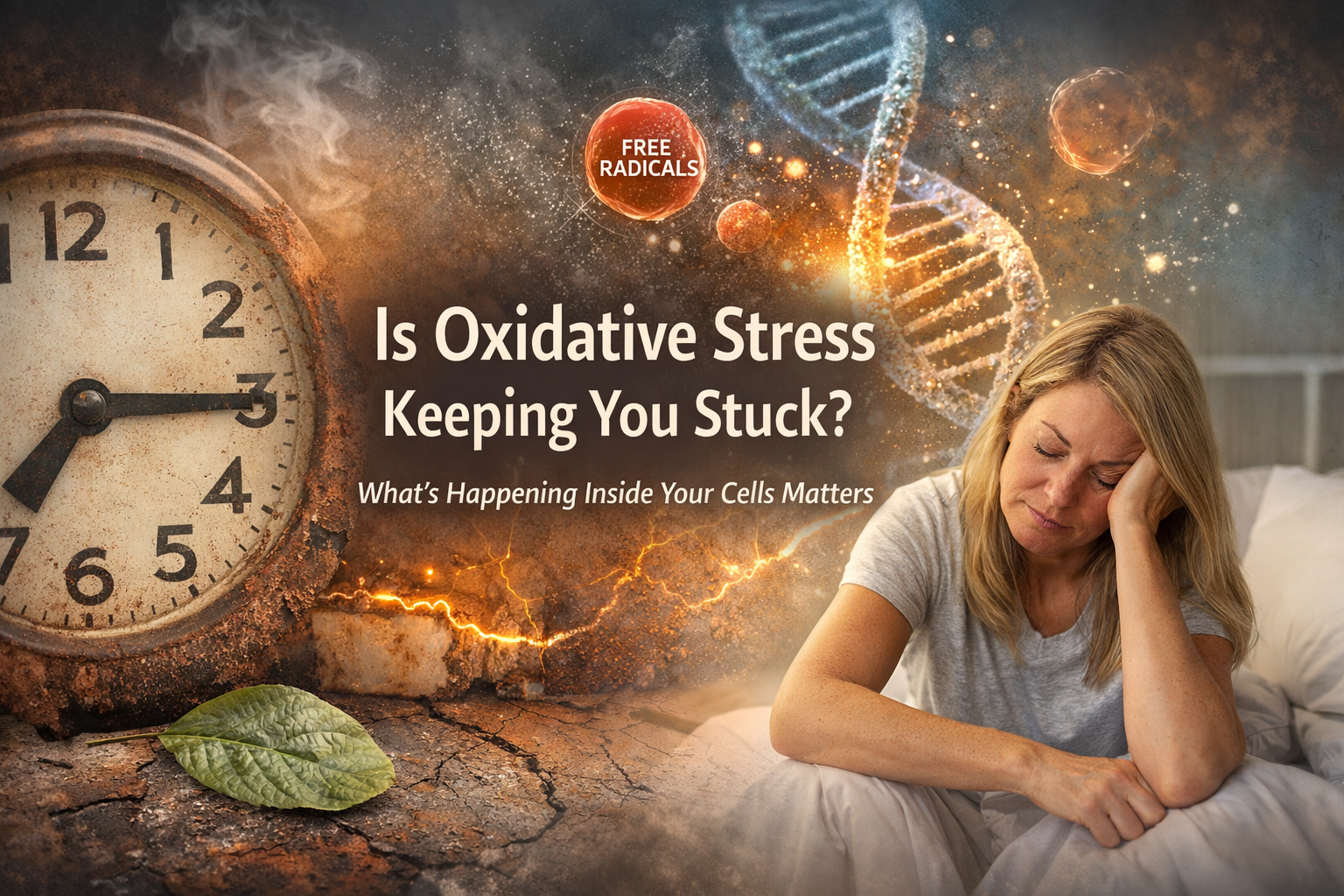
Oxidative Stress Keeping a Person Stuck
She was a chiropractor.
Eighteen years in practice. Trained in multiple natural healing modalities. Someone who spent her days helping other people feel better in their bodies.
And yet her hair was falling out. She had rashes on her neck and arms. Acne she had never dealt with as a teenager. She was exhausted in a way sleep couldn't fix.
Her labs came back normal.
That word. Normal.
If someone with that level of knowledge and access was still walking around feeling that way, what does that say about the rest of us?
More often than not, this is where oxidative stress comes into the conversation.
What nobody had explained yet was something called oxidative stress and why it matters more than most people realise.
It's not always about what you're doing wrong.
Sometimes it's about what's happening inside your body that no standard test is designed to catch.
So What Is Oxidative Stress, Really?
Oxidative stress happens when there is an imbalance between damaging molecules in the body, called free radicals, and the body's ability to neutralise them.
In a healthy, supported body, this balance is maintained naturally.
But when the body is under consistent pressure, from daily stress, environmental toxins, poor sleep, and emotional strain, that balance tips. And when it tips chronically, the impact goes deeper than how you feel on the surface.
It starts to affect your cells.
Think of it like rusting.
Oxidation is what happens to metal left out in the rain. You don't see the damage at first. But leave it long enough, and the structure weakens from within. Chronic stress can do something similar at the cellular level. Slowly. Quietly.
When this balance is off, the body has to work harder just to maintain normal function. Which is why energy feels harder to access, recovery takes longer, and you can feel older than you are, even when nothing specific is wrong.
Your body isn't failing you. It may just be overwhelmed.
The Stress Your Body Is Carrying
Most people think of stress as something they feel. A busy week. A hard conversation. A season of life that's just a lot.
But stress is also something your body does, automatically, continuously, often without you realising it.
Your nervous system has two main modes. The sympathetic state: fight, flight, freeze. And the parasympathetic state, the calm, the quiet, the recovery.
You need both.
But most of us spend the vast majority of our time in the first and very little in the second. Not because we're doing something wrong. Because the world we live in makes it genuinely hard to come back down.
And when this state remains active, it directly contributes to oxidative stress in the body.
Some stress is necessary. The problem is when the body forgets how to recover from it.
What Quietly Increases Oxidative Stress Over Time
There are three things that tend to tip the balance.
Thoughts. The internal lens through which you process everything. The story you're telling yourself about your body, your day, your life. That lens creates a measurable biological response, whether you realise it or not.
Toxins. What you're putting in and on your body every single day. The food, the water, the air, the products. The cumulative load most people carry today is significantly heavier than anything previous generations dealt with.
Trauma. Not just the big events. Also, the accumulation of smaller physical stresses. The long hours. The pushing through when your body is asking you to rest.
Think of your body like a cup.
Most of us are already nearly full before the day even begins. Every stressor, big or small, adds to that cup. And oxidative stress often occurs when it finally overflows.
Why Surface Habits Only Go So Far
Breathwork helps. Walking helps. Sleep matters. These are real, valuable things and absolutely worth doing.
But if oxidative stress has accumulated at the cellular level, surface habits are managing symptoms. They may not be reaching the source.
This is not about doing more.
It's about understanding what is happening beneath the surface and supporting the body where the issue actually lives.
If you've ever wondered how to actually support this process, this breaks it down simply.
What the Body Was Already Designed to Do
Here is what gives this conversation so much hope.
Your body already has a system for this.
There is a pathway inside your cells, often referred to as the body's natural defence system, specifically designed to manage oxidative stress. When it is working properly, your body produces its own protective enzymes. Its own internal defence.
The challenge is that this system slows down over time. Chronic stress slows it. Toxic load slows it. Age slows it.
And most people have never been told it exists, let alone that it can be supported.
If you want to understand how this connects to energy, brain function, and long-term cellular health, this is a good place to start.
The question worth sitting with isn't what can I add.
It's how I support what my body is already designed to do.
That reframe changes everything.
Your body was built to handle stress. It has remarkable systems designed specifically for that purpose.
The question is not whether those systems exist.
It's whether they are getting the support they need.
If this is something you've been feeling but couldn't quite explain, the fatigue, the slow recovery, the sense that something is off even when your labs say otherwise, I'm always here to talk it through. No pressure, just information.
This blog is for educational purposes only and is not intended to diagnose, treat, cure, or prevent any disease. Always consult your healthcare provider. Individual results may vary.
Remember to Do Things That Make You Smile
Health is wealth!
Monique Mannen